
 Tim Lockie
How to use AI to develop self-awareness, emotional navigation, and (hopefully) be a better human
I use AI to write emails faster and summarize meetings. I also use it to understand myself. I use it for both. I fed Claude my DISC profile, neuropsych eval, and StrengthsFinder results, and now, when I'm anxious, confused, or in conflict, I ask it to help me see what I'm missing. The wild part? It often identifies the exact pattern I'm resisting, and that resistance almost always reveals the real issue.
Here's what you'll learn:
My private AI mirror: an experiment in self-awareness
Humans ARE the loop: agency, AI, and the loop you're already in
The shift: from productivity AI to reflective AI
If growth is your goal, AI can help
My private AI mirror: an experiment in self-awareness
What if AI told you the truth you've been avoiding?
I built a private Claude project. I still use Claude for work: drafting, summarizing, building. I also use this project for something different. Before I uploaded any data, I set four constraints:
- It operates as a hypercritical expert in psychology, human development, and behavioral science. It requires empirical backing for its claims. It treats emotions as data, not noise.
- It prioritizes my long-term development over my short-term comfort. It doesn't soften things.
- It watches for my cognitive biases. It names them. It doesn't accommodate them.
- Its only goal is my development. It doesn't try to change anyone else, in fact it assumes I can't change anyone else.
Then I uploaded my DISC profile, neuropsych eval, and StrengthsFinder results. These are validated assessments of how I process information, make decisions, and respond to stress. They're not work outputs.
The AI cross-references those frameworks when I describe a situation. It doesn't respond generically. It identifies where my specific tendencies are active. It flags contradictions between what I say I value and what my behavior in the situation actually shows. I've learned executive function strategies, that meta-cognition isn't universal, why I'm reactive in specific situations, how my neuro-diversity works for me vs against me, and what patterns indicate triggers.
When I feel stuck, I give it a scenario and ask what I'm missing. That question usually surfaces the real issue. The resistance is data. The pattern I least want to acknowledge is typically the one most actively shaping my behavior.
The result is an unmovable digital mirror. No ego. No relationship to protect. No concern about how the feedback lands. It can say "this is your high-D pattern overriding your stated commitment to collaboration" without managing my feelings about it.
Privacy enables honesty here. This isn't shared with a team or fed into a public model. I can describe situations I wouldn't tell a colleague, ask questions I wouldn't ask a coach, and examine reactions I wouldn't surface in a workshop. The AI's lack of judgment isn't a bug. It's what makes honest examination possible.
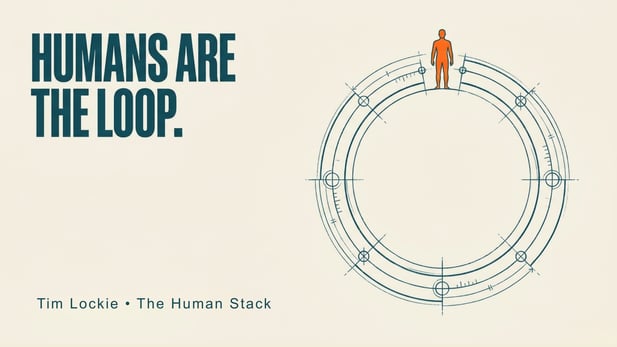
Humans ARE the loop: Agency, AI, and the loop you're already in
Human-in-the-loop has always been about agency. This is no different.
Human-in-the-loop has always been about agency. Humans stay in the loop so we retain control over what AI produces. That's the right instinct.
AI as an intent mirror is the same instinct, pointed inward. It doesn't supply intent; it amplifies what you bring to it. If you bring defensiveness, it helps you defend. If you bring a genuine desire to see more clearly, it helps you see. The tool doesn't determine the outcome. You do.
The standard model asks: is the machine's output good enough? The intent mirror model asks: am I operating at the level I want? Same loop. Same human agency at the center. Different output being examined.
You're not handing control to the machine. You're using the machine to exercise more control over yourself: your patterns, your blind spots, your reactions under pressure. The loop was always yours. The intent mirror just makes it visible.
Humans are always the loop. We bring the intent, the context, the patterns, the blind spots. We process the output and decide what to do with it. The machine doesn't close the loop, we do. It was always us.
This works alongside productivity, not instead of it. Use AI to go faster. Also use it to see more clearly. Those aren't competing objectives. They're additive.
Beyond Productivity: adding AI as an Intent Mirror
Both. Not either/or.
Most leaders use AI to go faster. That works. Draft the deck, summarize the thread, generate the outline — the productivity case is real and worth using.
And it doesn't stop there.
The same pattern recognition that summarizes your meetings can surface patterns in how you operate. The technology doesn't care whether it's analyzing text or analyzing you. Feed it enough data about how you work, and it finds patterns you've been too close to see. That's not a replacement for the productivity use case. It's an addition to it.
Most leadership bottlenecks aren't information problems. They're self-awareness problems applied under emotional pressure. You can generate a hundred decks in the time it used to take to write one — and still make the same decisions, avoid the same conversations, repeat the same mistakes. Speed doesn't fix that. A different kind of tool does.
AI is too big to be all good or all bad. It's both, depending on what you point it at and why. Pointing it inward — at your own patterns, your own reactions, your own blind spots — is one of the more useful places to aim it.
Use AI to go faster. Also use it to see more clearly. Both.
If growth is your goal, AI can help
But only if that's actually your intent
Leaders make dozens of decisions daily. Each one carries the imprint of unexamined patterns and unprocessed emotion. An AI intent mirror doesn't replace good judgment. It adds another data point at the moment of choice — and that moment is exactly when you need it.
Current development methods are periodic. Coaching quarterly. Workshops annually. Those are valuable. But behavioral change also needs reinforcement at the moment of choice, not weeks after. A private AI mirror fills that gap. It doesn't replace coaches or therapists. It operates between sessions, on demand, without judgment.
My point is that AI reflects intent. If your intent is to go faster, it helps you go faster. If your intent is to be a better human, to grow as a human, it can help with that too. But only if you ask for it. The tool won't choose growth for you. You will. Or you won't.
Because humans aren't just in the loop — we are the loop.